Is There Still Room for Your Business Online?
The online world feels more crowded than ever. But that doesn’t mean you’ve missed your chance.
Have you ever looked around online and wondered…
Does the world really need another business doing what I do?
Maybe you’ve searched for your services and found pages and pages of businesses offering something similar.
You’ve looked at competitors with polished websites, years of content, thousands of followers and beautifully curated social media feeds.
And suddenly that little voice starts:
Maybe I’m too late.
Maybe everyone else already has this covered.
Maybe there’s no room for me.
If you’ve ever thought that, you’re certainly not alone.
But after spending many years building websites, creating online businesses and watching the online world change, I’ve come to believe something quite different.
You don’t need to find an empty corner of the internet.
You need to create a clear, useful place for the people you are best equipped to help.
And those are two very different things.
Yes, the internet is crowded
Let’s get this one out of the way first.
Yes.
There are a lot of businesses online.
Whatever you do, there’s a good chance someone else is already doing something similar.
There are thousands of photographers.
Coaches.
Bookkeepers.
Designers.
Consultants.
Crafters.
Course creators.
Tradies.
Virtual assistants.
Online educators.
And just about every other type of business you can imagine.
So if your goal is to find a business idea that absolutely nobody else has thought of before, you’re going to make this much harder than it needs to be.
Because competition isn’t necessarily the problem.
Being unclear is.
A potential client isn’t sitting at home thinking:
“I need to find the only bookkeeper in Australia.”
She’s thinking:
“I need someone who understands my small business, explains things without making me feel silly and can help me sort this mess out.”
That’s an entirely different problem to solve.
And that’s where there’s still plenty of room.
You don’t have to be completely unique
This is one of the biggest traps I see small business owners fall into.
They think they need a revolutionary business idea.
A completely unique service.
A clever niche nobody has discovered.
Or a website unlike anything that’s ever existed before.
You don’t.
There may be hundreds of people who technically offer the same service you do.
But they aren’t you.
They don’t have your experience.
Your personality.
Your way of explaining things.
Your processes.
Your values.
Your approach to working with clients.
And perhaps most importantly, they won’t connect with exactly the same people you do.
Think about the businesses you personally choose to work with.
You probably don’t always choose the biggest.
Or the cheapest.
Or the one with the fanciest website.
Often, you choose the person who makes you think:
“Yes. They understand what I need.”
That’s what your website needs to communicate.
Not:
“Look how impressive I am.”
But:
“You’re in the right place. I understand the problem you’re trying to solve, and here’s how I can help.”
Your website doesn’t need to do everything
This is where I see another problem creeping in.
Small business owners look at established businesses and assume they need everything those businesses have.
A blog.
A shop.
A funnel.
An email list.
Automations.
Online courses.
A membership.
A booking system.
A resource library.
A quiz.
Seventeen lead magnets.
And apparently we’re all supposed to be making Reels somewhere in between.
No wonder your website has been sitting on the to-do list for six months.
The problem isn’t necessarily that you’re bad at technology.
You may simply be trying to make too many decisions at once.
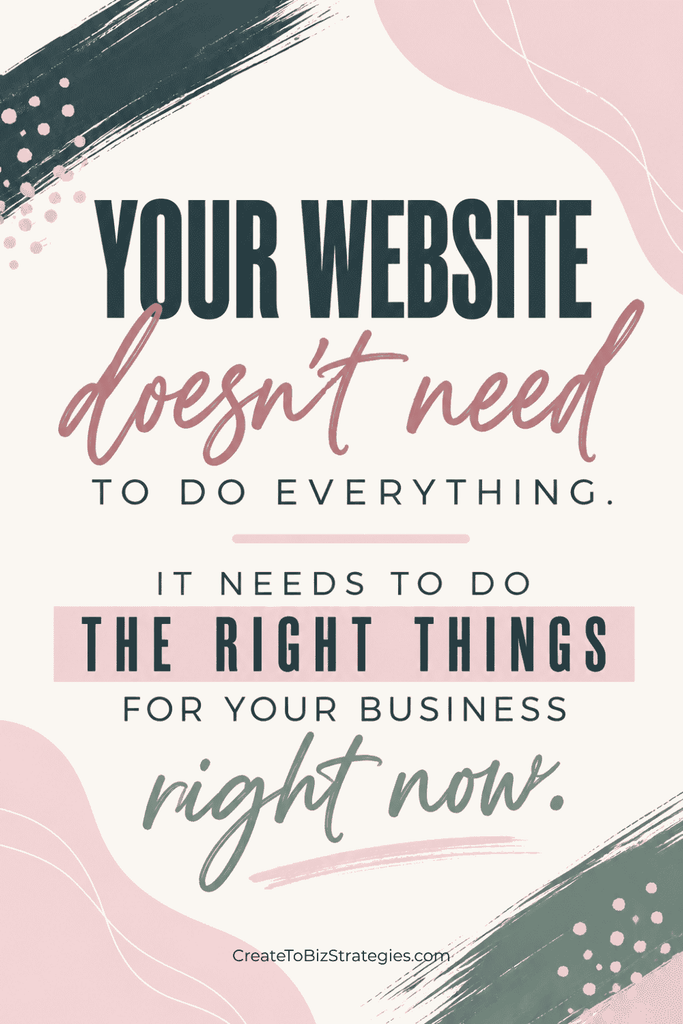
Your website doesn’t need to do everything another business’s website does.
It needs to support your business at its current stage.
For one business, that might mean a simple website explaining who they are, what they offer and how to contact them.
For another, it might mean an online shop.
Someone else might need a membership area or course platform.
And an established business may be ready for integrations, automations and more sophisticated systems.
None of those businesses is doing it “better”.
They’re simply at different stages.
Start with what your business needs now
Instead of asking:
“What should my website have?”
I prefer to start with a different question:
“What does my business need my website to do?”
That question tends to make things much clearer.
Maybe you need people to understand your services.
Maybe you’re constantly answering the same questions and need somewhere to send people for information.
Maybe people are finding you through social media but have nowhere to learn more about working with you.
Maybe you’re ready to sell a digital product.
Maybe your website already exists, but you’re slightly terrified every time you need to change something.
Or perhaps it technically works, but you’ve added plugins, pages and workarounds over the years and now you’re not entirely sure what’s connected to what.
That’s okay.
You don’t have to solve everything today.
You just need to identify the next problem worth solving.
That’s where clarity starts.
More isn’t always better
There is a lot of advice online about what a “successful” website should have.
And some of it is useful.
But more pages don’t automatically make a better website.
More plugins don’t automatically make a better website.
More features certainly don’t make a better website.
Sometimes they simply give you more things to maintain.
A good website should make running your business easier, not create another part-time job.
I’d rather see a small business owner with five clear, useful pages she understands than a complicated website with twenty-seven plugins she’s afraid to touch.
Because your website shouldn’t feel like this mysterious thing sitting somewhere on the internet that you’re scared of breaking.
Over time, you should understand what it does.
You should know what matters.
You should feel confident making everyday updates.
And when something does need technical help, you should know where to turn.
That’s a very different definition of a successful website.
Your website doesn’t have to appeal to everyone
This one can take a little getting used to.
Your website isn’t supposed to convince every person who visits it to work with you.
In fact, I don’t think that’s a particularly useful goal.
Your website should help the right people decide whether you’re the right person for them.
There will always be people who want the cheapest option.
People who want a different style.
People who prefer a larger company.
People who want to DIY absolutely everything.
People who want a service you don’t provide.
That’s perfectly fine.
Clarity doesn’t just attract the right clients.
It also helps the wrong clients recognise that you’re probably not the right fit.
And that saves everyone time.
You haven’t missed your chance
So, is there still room for your business online?
I believe there is.
Not because competition doesn’t exist.
And not because everyone who creates a website automatically builds a successful business.
There’s room because people are still looking for solutions.
They’re looking for people they trust.
They’re looking for businesses that understand their particular situation.
And they’re looking for someone who can make things feel a little easier.
You don’t need to become the biggest business in your industry.
You don’t need thousands of followers.
You don’t need every possible piece of technology.
And you certainly don’t need to build the final version of your website before you’re allowed to begin.
You need something much simpler.
A clear website that supports the business you’re building and helps the right people take their next step with you.
And then, as your business grows, your website can grow with it.
If your website currently feels overwhelming…
Don’t start by asking what you need to add.
Start by getting clear on what’s happening now.
Ask yourself:
- What is already working?
- What feels confusing or frustrating?
- What are you avoiding because you don’t know how to do it?
- What do your customers need to be able to find or do?
- What does your business need next?
- And what can safely wait?
You don’t need to become “good at tech”.
And you don’t need to figure everything out alone.
Sometimes the most useful next step is simply having someone look at what you’ve already got, explain what’s actually happening in plain English and help you work out what needs attention first.
Because once you have clarity, your website stops feeling like one enormous problem.
It becomes a series of manageable next steps.
And that’s when things start to feel a whole lot easier.

